

Category
Recommended Products
CI503P COLOR ANALYZER
CI550 COLOR ANALYZER
CL138 UV light meter
CI510 COLOR ANALYZER
CL503 illuminance colorimeter
CI300 Color Analyzer
CL300 illuminance colorimeter
CI820 SPECTRAL LUMINANCE COLORIMETER
CL320 UV Meter
CI350 LUMINANCE COLORIMETER
Contact Us
E-mail:info@huicolor.com
Tel:0086 755 2317 9385
Mobile:0086 135 0006 9487
Technical Articles
Basic knowledge of light source color rendering index(CRI)
- Time:2024-07-30
- Visits:1
In 1664, Newton used a prism to disperse white sunlight into spectra with different tones, which laid the physical foundation of light color.
At present, it is generally accepted that light is a special substance ,which is transmitted in the form of electromagnetic waves, the wavelength range of visible light is about 380 nm ~ 780 nm, the human eye can see the color of various objects with visible light.For a long time, human beings have been adapted to work in sunlight,and rely on flames to obtain light at night,under these natural light conditions, human color vision is constant, believing that the colors seen under these two light sources are the "real" colors of objects.
Some modern new light sources, such as LED, mercury lamp, sodium lamp, etc,its light color may be similar to sunlight,but its spectral power distribution is quite different from them,therefore, the color of the object seen under these new light sources is different from that seen under sunlight.For example, if you observe a piece of floral cloth in sunlight and then take it under a high-pressure mercury lamp, you will find that some colors have changed, such as pink turns purple and blue turns blue-purple, under the high-pressure mercury lamp, the object loses its "real" color, or the color is distorted.
In order to evaluate this situation, CIE introduced the calculation method of light source color rendering index (revised in 1974), which uses 14 standard samples and compares them with the standard light source and the test light source for illumination, and the color difference of the standard samples under the illumination of the two light sources was evaluated, and then the color rendering performance of the light source to be tested, namely the color rendering index CRI, the larger the value, the better the color rendering, and the smaller the value, the worse the color rendering. The simulated colors of these 14 standard samples are shown in the following figure.
The CRI color reproducibility index has certain limitations, The North American Institute of Lighting Engineering ( IES ) proposed a color quality index CQS ( Color Quality Scale ) to evaluate the color quality of light sources, which more comprehensively evaluated the ability of light sources to restore the color of objects. It uses 14 new standard samples to simulate colors, as shown in the following figure.
In May 2015, the North American Illumination Society ( IES ) approved named IES Method for Evaluating Light Source Color Rendition ( TM-30-15 ), with 99 evaluation reference templates, which is currently recognized as a more accurate and objective light color evaluation index, including fidelity Rf and color gamut index Rg.
The Television Light Source Consistency Index (TLCI-2012) was launched by the British Broadcasting Corporation (BBC) to solve the color rendering measurement of TV and video cameras.
The color rendering performance of lighting sources is very important. For example, such as the standard eye protection lamp for teenagers, it is clearly stated that the color rendering index should be greater than 80, and many engineering lighting standards also have clear requirements for the color rendering index.
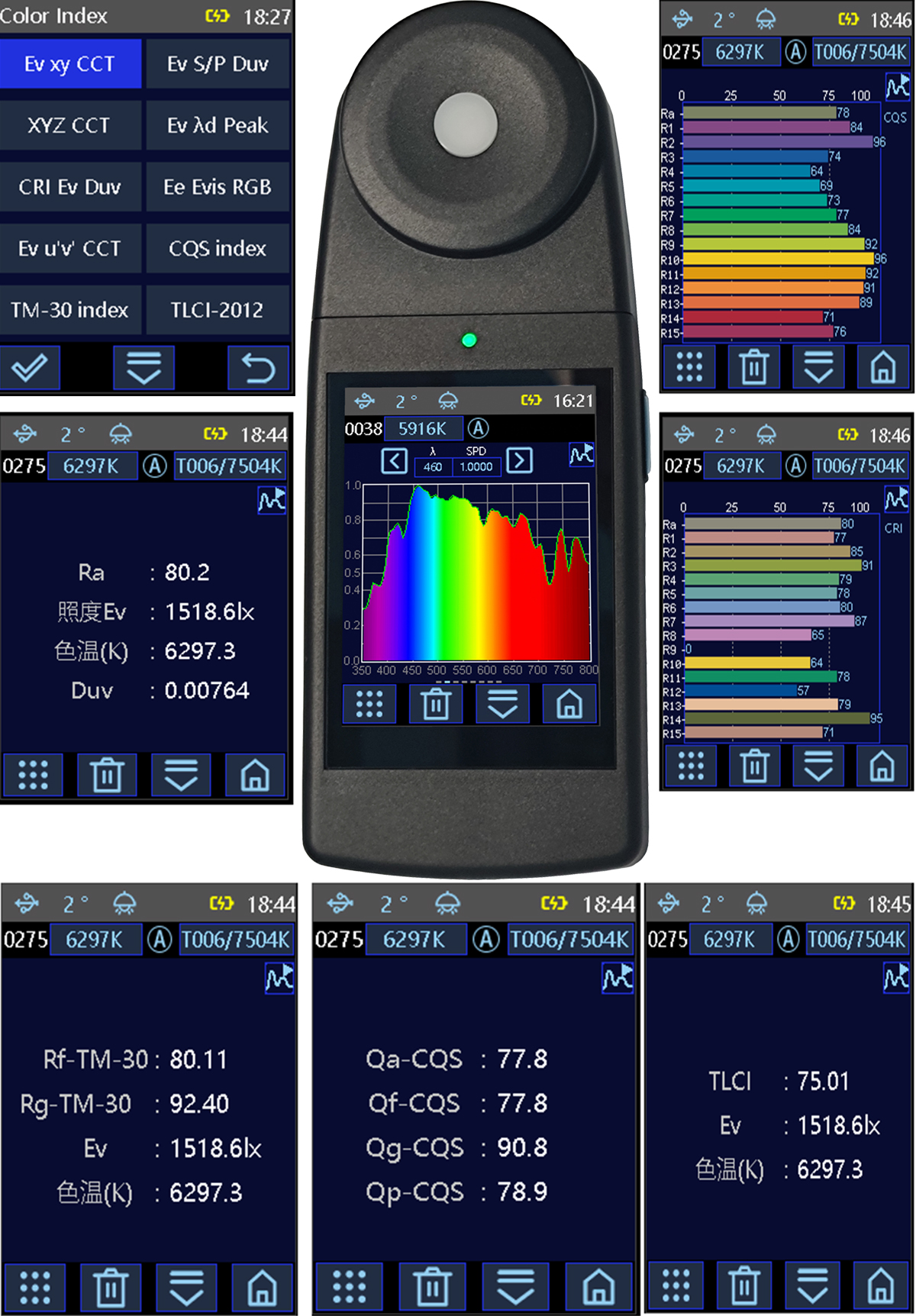
There are so many color rendering indices that are overwhelming and difficult to start with. Color technology is so close that it can be tested with just one click using the CL800 series spectrophotometer, as shown in the following figure!